Yes, most healthy adults can. Retinol and peptides do different jobs, and there is no known clash between retinol and most peptides. Use retinol at night, add a peptide product in the morning or after retinol, and wear sunscreen every day. Introduce one at a time so you can tell which one irritates your skin.
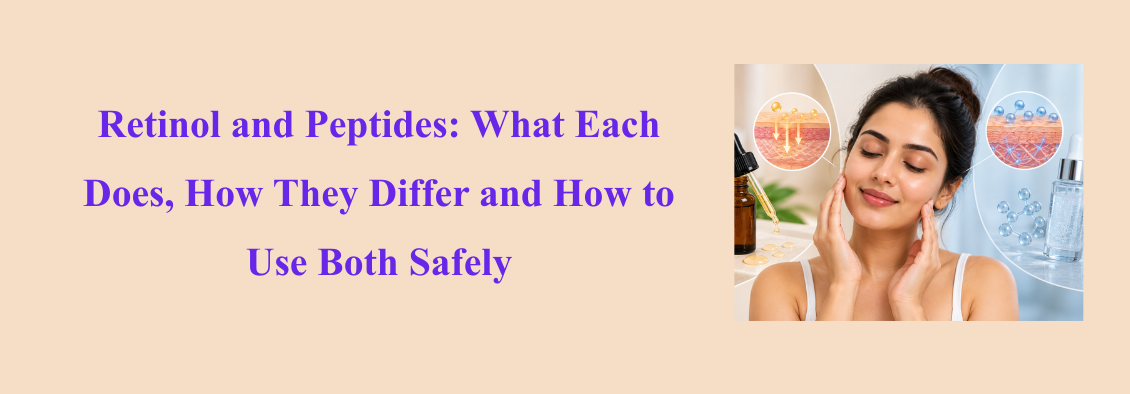
Retinol and Peptides: What Each Does, How They Differ and How to Use Both Safely
By Dr. Harish B (B.D.S, F.A.M, F.H.T, MBA-HM), Founder, Livglam Aesthetic Clinic, Jayanagar, Bangalore | Last updated: 28 September 2026
Retinol and peptides both appear on anti-ageing labels, but they are not interchangeable. Retinol is a form of vitamin A that speeds up skin cell turnover and supports collagen, and it has the longer research record. Peptides are short chains of amino acids that act as signals to skin cells. They are gentler, and the evidence for them is thinner. Most healthy adults can use both, at different times of day. Two rules matter more than any product choice: wear sunscreen every morning, and stop retinol if you are pregnant.
Retinol vs peptides at a glance
| Retinol | Peptides | |
|---|---|---|
| What it is | A vitamin A derivative, part of the retinoid family | Short chains of amino acids, the building blocks of proteins such as collagen |
| How it works | Speeds up turnover of surface skin cells and supports collagen | Acts as a signal or carrier for skin cells. Depending on the type, it may prompt collagen, deliver minerals or soften expression lines |
| Best for | Fine lines, uneven texture, mild pigmentation and mild acne | Firmness and fine lines in skin that can't take retinol, and gentle daily support |
| Research record | Longer and stronger | Promising but thinner, and limited by how well peptides get into the skin |
| Speed of results | Several weeks for texture, three to six months for visible photoageing changes | Gradual, and usually modest |
| Irritation | Common at first: dryness, redness, peeling | Usually low |
| Sun sensitivity | Yes. Use at night and wear sunscreen every morning | Not known to cause it, but wear sunscreen every day anyway |
| Pregnancy | Avoid | Not a vitamin A product, but check any new product with your doctor |
What does retinol do for your skin?
Retinol is vitamin A in a form skin cells can use, and it works in two ways. It speeds up the turnover of surface cells, so dull, rough skin is replaced sooner, and it supports collagen, the protein that keeps skin firm. The American Academy of Dermatology says retinoid products suit mild fine lines, mild pigmentation irregularities and mild acne.
The benefits of retinol for skin show up slowly. Cleveland Clinic says retinol starts working in your cells right away, but it takes several weeks before you see a change in how your skin looks and feels. For photoageing, a review in the ACOFP journal puts visible results at three to six months of regular use, and says the benefits fade when you stop. Treat retinol as a long-term habit, not a course.
Retinol vs retinoid: what is the difference?
Retinoid is the family name for every vitamin A derivative. Retinol is the milder, over-the-counter member of that family. Stronger retinoids such as tretinoin are prescription medicines and should be started under a doctor's guidance. The American Academy of Dermatology points out that over-the-counter labels don't have to state how much retinol a product contains, so start with the gentlest product you can find.
What are peptides in skincare?
A peptide is a short chain of amino acids, and enough of them linked together make a protein such as collagen. In skincare the word covers hundreds of different molecules, which a 2025 review in the journal Biomolecules sorts into four groups:
- Signal peptides tell skin cells to make more collagen and elastin.
- Carrier peptides deliver trace minerals, such as copper, that skin uses for repair.
- Neurotransmitter-inhibitor peptides aim to soften expression lines by reducing the signals that make muscles contract.
- Enzyme-inhibitor peptides slow down the enzymes that break collagen down.
The limits are real. Peptides are large molecules, and the same review names poor permeability through the skin's outer layer as one of the biggest drawbacks of cosmetic peptides, which is why the formula matters as much as the peptide. Peptides for skin can improve the look of fine lines and firmness, but the effect is modest and they are less well studied than retinoids. A label that says "peptide complex" tells you almost nothing without the type and the amount.
Can you use retinol and peptides together?
Yes, for most healthy adults. The two work through different routes, and there is no known reason to avoid using retinol and peptides in the same routine. A simple way to do it:
- Morning: cleanser, a peptide serum or moisturiser if you use one, then sunscreen.
- Night: cleanser, retinol on dry skin, then a moisturiser. Some people put the peptide product on after the retinol on these nights.
Add one new product at a time, two weeks apart, so you know what caused any irritation. If your skin is sensitive, start with peptides alone for a few weeks and bring retinol in later. Don't stack too many actives at once. A retinol night with a strong exfoliating acid on top is a common way to end up with an irritated skin barrier. Many products now combine both in a single serum, which is convenient, but you can't adjust either strength separately, so patch test it and introduce it slowly. Our guide to skin serums covers layering in more detail.
How to use retinol safely
- Patch test first. Apply a small amount to your inner forearm or a small patch of face for a few nights before using it more widely.
- Choose the lowest strength you can find. The American Academy of Dermatology advises the least intense formula, to avoid irritating your skin.
- Use a pea-sized amount for the whole face.
- Apply it at night to clean, dry skin, then follow with a non-comedogenic moisturiser.
- Start every other night. Move up only when redness and peeling have settled.
- Wear a broad-spectrum sunscreen of SPF 30 or higher every morning.
- Keep it away from your eyes, mouth and nostrils. For the under-eye area, use a product made for it. Our guide to dark circles covers eye-area care.
- Judge results after about three months, not three weeks.
Retinol side effects and the retinol purge
Redness, itching, dryness, peeling and mild burning are common in the first weeks, and they usually ease as skin gets used to retinol, according to Cleveland Clinic. Some people also break out more for a while, and skin can look worse before it looks better. That is what people call the retinol purge. Cut back to fewer nights rather than pushing through.
Stop the product and see a doctor if you get swelling, blisters, a rash, burning that doesn't settle, or new dark patches. On deeper skin tones, irritation that is ignored can leave dark marks that take months to fade, which is a good reason to go slowly.
Who should avoid retinol?
- Anyone who is pregnant. The American Academy of Dermatology advises avoiding retinoids, including over-the-counter retinol, during pregnancy. If you are breastfeeding or planning a pregnancy, ask your doctor first.
- Anyone with sunburnt, broken or very inflamed skin, until it has healed.
- Anyone about to have a peel, laser or similar treatment. Clinics generally ask you to pause retinol before and after. The aftercare for a BB Glow treatment at Livglam, for example, says to avoid retinol or Retin-A for one week.
- Anyone using hair removal cream on the same skin. Cleveland Clinic lists retinoid use as a reason to avoid depilatory creams, because retinoids make skin more sensitive. Our guide to hair removal cream vs laser hair removal explains the risks.
When creams are not enough
Retinol and peptides work at the top of the skin, and peptides in particular struggle to get any deeper. In-clinic treatments can reach layers a cream can't. Biorevitalisation, for example, delivers peptides and cross-linked hyaluronic acid into the dermis, which our guide to top anti-ageing treatments describes, while peels and lasers work on texture and pigment. Which one suits you depends on your skin, your age and what you want to change, and that is a decision for a doctor after examining your skin. Livglam Aesthetic Clinic in Jayanagar, Bangalore, lists the options on its anti-ageing treatment page.
When to see a doctor
- Irritation doesn't settle when you cut back, or it keeps getting worse.
- You get swelling, blistering, a rash or burning that doesn't fade.
- New dark patches or marks appear.
- You are pregnant, or you become pregnant, while using retinol. Stop the product and ask your doctor.
- You want a prescription retinoid, or you have acne, pigmentation or scarring that products aren't shifting.
- You are not sure which products suit your skin.
The bottom line
Retinol does more, and asks more of your skin. Peptides do less, and ask less. For most adults a sensible plan is sunscreen every morning, retinol a few nights a week once your skin tolerates it, and a peptide product if you want something gentler alongside it. Give it three months before you judge. If you are pregnant, drop the retinol and keep the sunscreen.
Frequently asked questions
1. Can you use retinol and peptides together?
2. Which is better, retinol or peptides?
Retinol does more and has more research behind it, but it irritates more. Peptides are gentler and their results are more modest. If your skin tolerates it, retinol is the stronger choice for fine lines and texture. If your skin is sensitive, peptides are the easier place to start. If you're pregnant, avoid retinol and ask your doctor what to use instead.
3. What does retinol do for skin?
Retinol is a form of vitamin A that speeds up skin cell turnover and supports collagen. Over several weeks to months, that can smooth texture, soften fine lines and improve mild pigmentation and mild acne. The benefits fade if you stop using it.
4. How do I use retinol for the first time?
Start with the lowest strength you can find, apply a pea-sized amount at night to clean, dry skin, and use it every other night at first. Follow with a moisturiser and wear sunscreen every morning. If your skin is irritated, cut back rather than push through. If you're unsure which strength suits your skin, a skin assessment at a clinic such as Livglam Aesthetic Clinic in Jayanagar, Bangalore, can help.
5. How often should you use retinol?
Start with every other night, or once or twice a week if your skin is sensitive, and increase only once redness and peeling have settled. Some people end up using it every night and others stay at two or three nights a week. Using it more often doesn't give faster results, it gives more irritation.
6. What are peptides in skincare?
Peptides are short chains of amino acids, the building blocks of proteins such as collagen. In skincare they act as signals or carriers: some prompt skin cells to make collagen, some deliver minerals like copper, and some aim to soften expression lines. The word covers hundreds of different molecules, so results depend on the peptide and the formula.
7. Do peptides actually work?
They can, but the effect is modest. Studies point to improvements in fine lines and firmness, and reviews note that peptides are large molecules that struggle to cross the skin's outer layer. They are less well studied than retinoids, so treat them as a gentle addition, not a replacement.
8. Does retinol make skin more sensitive to the sun?
Yes. The American Academy of Dermatology says retinoids can make skin more sensitive to the sun, which is why retinol is used at night and sunscreen is worn every morning. Peptides are not known to cause this on their own, but daily sunscreen is worth wearing either way.
9. Is retinol safe during pregnancy?
No, the safer choice is to avoid it. The American Academy of Dermatology advises avoiding retinoids, including over-the-counter retinol, during pregnancy. If you find out you're pregnant while using it, stop the product and ask your doctor. Sunscreen and a plain moisturiser are a safe base routine.
10. What is retinol purge?
Retinol purge is a temporary flare of dryness, flaking and small breakouts in the first weeks of using retinol, as skin renews faster. It usually settles as the skin adjusts. Burning, swelling, blisters or a rash aren't a purge, so stop the product and see a doctor.
References
- American Academy of Dermatology. Retinoid or retinol? https://www.aad.org/public/everyday-care/skin-care-secrets/anti-aging/retinoid-retinol
- American Academy of Dermatology. Dermatologist-approved pregnancy skin care. https://www.aad.org/public/everyday-care/skin-care-secrets/routine/pregnancy-skin-care
- Cleveland Clinic. Retinol: Cream, Serum, What It Is, Benefits, How To Use. https://my.clevelandclinic.org/health/treatments/23293-retinol
- Cleveland Clinic. Depilatory Cream: Benefits, Risks and How To Use. https://health.clevelandclinic.org/depilatory-cream-hair-removal
- Vitamin C, Topical Retinoids, and Sunscreen in Clinical Practice: Essentials for Family Physicians. ACOFP journal, Fall 2024. https://acofp.org/news-and-publications/journal/article-detail/vol-16-no-3-fall-2024/vitamin-c-topical-retinoids-sunscreen-in-clinical-practice-essentials-for-family-physicians
- Pintea A. et al. Peptides: Emerging Candidates for the Prevention and Treatment of Skin Senescence: A Review. Biomolecules, 2025. https://pmc.ncbi.nlm.nih.gov/articles/PMC11762834/
Recent Blogs







Book your slot to know things about laser treatment!
Just a click away to experience high quality aesthetic treatments.